Ash Wednesday 2026
“To be forgetful of death is to be forgetful of life” - Ladislaus Boros, The Mystery of death

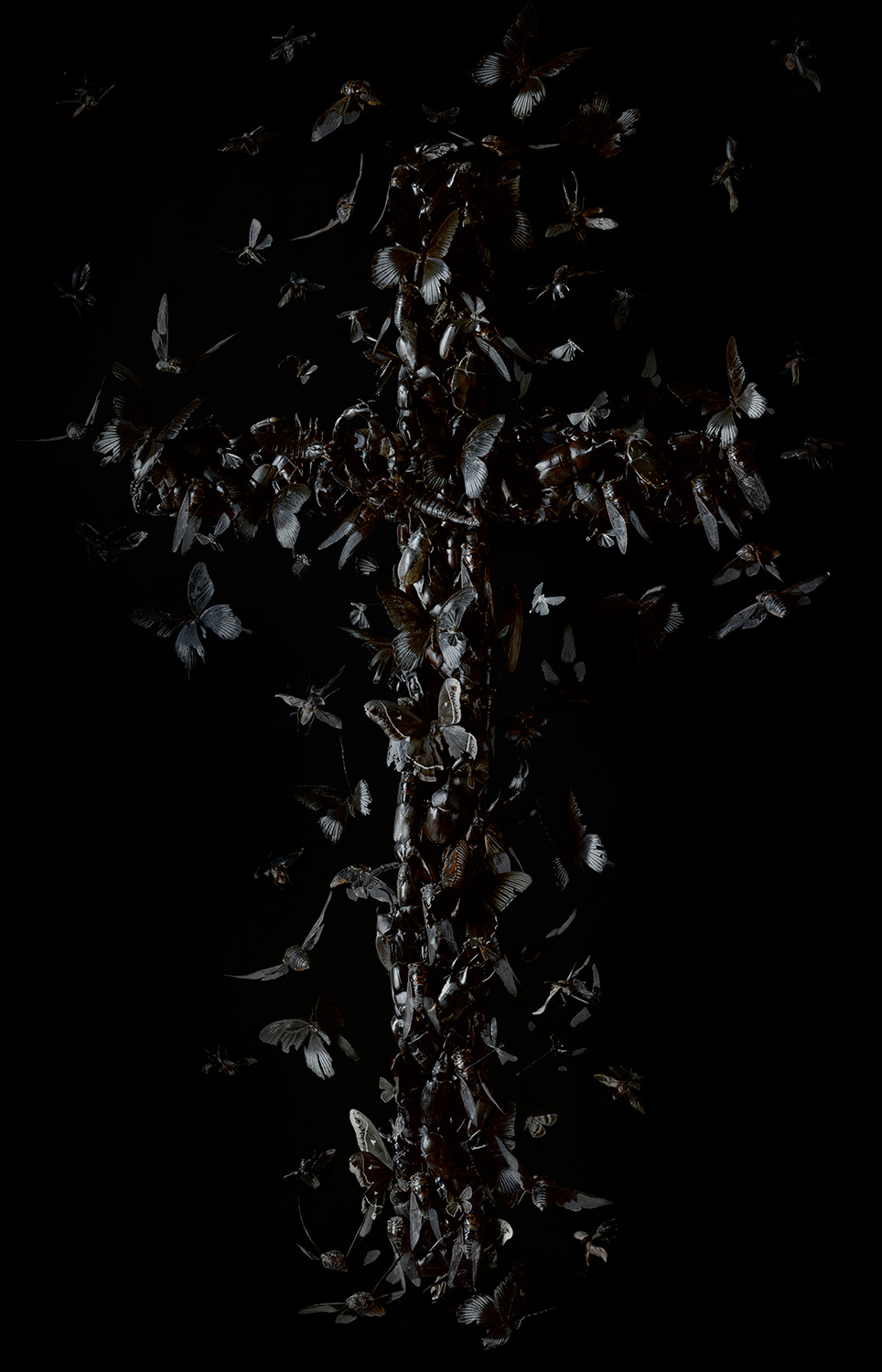
Tara Sellios (American, 1987–), Umbra, 2024, from the series Ask Now the Beasts. Inkjet print from 8 × 10 negative, 55 × 35 in. Source
The Other Deepest Thing is an occasional space for looking at grief and loss and longing. I write here from a place of deep loss and the deeper still mercy that I’ve found in the person of Jesus and other broken and grieving people. Here I reflect, sometimes offer practices, sometimes ask questions, sometimes just vent.
Lent’s a unique time to choose sadness, to lament, which, if you’ve had tragedy dropped on you like a piano from a twenty story building, can sound bat shit crazy. Who in their ever loving mind would choose that?
Believe me, I get it. If you’re right now in the midst of deep grief and sadness, you can give this little Lenten series a pass. But if you’re “Lent curious” or close to someone who’s in the black pit of pain and you want to know how to sidle up alongside them and offer your presence, maybe stick around.
I’m no expert on Lent. I didn’t grow up in a community that followed the liturgical Church calendar. We were an Easter people and, if the truth be told, Easter played second fiddle to Christmas. Opening day of dove, deer and football season were all unofficially but almost universally recognized as well.
But Lent? That was for the Catholics, poor souls.
Yet here I am, dipping my thumb in some oiled ashes and marking people’s foreheads while reminding them they came from dust and will one day crumble back into it. Not as a priest, but as a practitioner, a stumbling Jesus follower who is constantly finding that this Way we walk behind him is a full 360 degree, IMAX broad spectrum, 24 and 7 and 365 experience. Not always nice or easy, often damned near impossible, but more real and meaty than anything else on tap.
This year I’m listening to Art and Theology’s Lent Playlist, reading The Mystery of Death by Ladislau Boros, For Such A Time As This by Hanna Reichel, Bread and Wine from Plough Publishing and clicking on the Lent Project from CCCA. You’ll probably hear echoes of these works in the weeks to follow.
I’m also working out a Lenten form of the Practice of Prayer I just wrote about over on The Shape of our Desire.
Through it all I’m asking what it means to consider my own death as a way of understanding my life. How is that understood when framed and interacting with the life, death and resurrection of Jesus? Boros continues in The Mystery of Death “For if human death has no meaning, then the whole of life is nothing but emptiness. If, on the other hand, there is in death a fullness of being which life does not possess, then life itself must be subjected to a thoroughgoing reinterpretation and reevaluation. It is a strange thing that the search for some context in life and some continuity in human existence should have to start off as an enquiry into the meaning of death”
So let’s start with clear eyed sobriety considering our death this Lent, shall we?
Grace and peace y’all,
PS, if you’re feeling overwhelmed with all this, or got a late start, don’t worry. Start with the Bread and Wine devotional or the Lent Project emails, jump in midstream and ride along. Play the long game and tell that inner perfectionist critic to shut it’s damn pie-hole.
Adapted from the original notebook fragment written
by Rainer Maria Rilke in Spain in 1913
Evidently, this was needed. Because people need
to be screamed at with proof.
But he knew his friends. Before they were
he knew them. And they knew
that he would never leave them
there, desolate. So he let his exhausted eyes close
at first glimpse of the village fringed with tall fig|
trees —
immediately he found himself in their midst:
here was Martha, sister of the dead
boy. He knew
she would not stray,
as he knew which would;
he knew that he would always find her
at his right hand,
and beside her
her sister Mary, the one
a whole world of whores
still stood in a vast circle pointing at. Yes,
all were gathered around him. And once again
he began to explain
to bewildered upturned faces
where it was he had to go, and why.
He called them “my friends.” The Logos, God’s
creating word, — the same voice that said
Let there be light.
Yet
when he opened his eyes,
he found himself standing apart.
Even the two
slowly backing away, as though
from concern for their good name.
Then he began to hear voices;
whispering
quite distinctly,
or thinking:
Lord,
if you had been here
our friend might not have died.
(At that, he slowly reached out
as though to touch a face,
and soundlessly started to cry.)
He asked them the way to the grave.
And he followed behind them,
preparing
to do what is not done
to that green silent place
where life and death are one.
By then other Brueghelian grotesques
had gathered, toothlessly sneering
across at each other and stalled
at some porpoise or pig stage
of ontogenetical horrorshow, keeping
their own furtive shadowy distances
and struggling to keep up
like packs of limping dogs;
merely to walk down this road
in broad daylight
had begun to feel illegal,
unreal, rehearsal,
test — but for what!
And the filth of desecration
sifting down over him, as a feverish outrage
rose up, contempt
at the glib ease
with which words like “living”
and “being dead”
rolled off their tongues;
and loathing flooded his body
when he hoarsely cried,
“Move the stone!”
“By now the body must stink,”
some helpfully suggested. But it was true
that the body had lain in its grave four days.
He heard the voice as if from far away,
beginning to fill with that gesture
which rose through him: no hand that heavy
had ever reached this height, shining
an instant in air. Then
all at once clenching
and cramped — the fingers
shrunk crookedly
into themselves,
and irreparably fixed there,
like a hand with scars of ghastly
slashing lacerations
and the usual deep sawing
across the wrist’s fret,
through all major nerves,
the frail hair-like nerves —
so his hand
at the thought
all the dead might return
from that tomb
where the enormous cocoon
of the corpse was beginning to stir.
Yet nobody stood there —
only the one young man,
pale as though bled,
stooping at the entrance
and squinting at the light,
picking at his face, loose
strips of rotting shroud.
All that he could think of
was a dark place to lie down,
and hide that wasted body.
And tears rolled up his cheek
and back into his eyes,
and then his eyes began
rolling back into his head...
Peter looked across at Jesus
with an expression that seemed to say
You did it, or What have you done?
And everyone saw
how their vague and inaccurate
life made room for his once more.
I love the whole idea of exploring our own mortality as a means of understanding life. I have a friend who, like me, has had to face his own mortality in a very real way. Kidney disease for him, cancer for me - and we're both fine...but having had to face it, means a different lens for living.